What Is the Best Flush Door Type from China?
Choosing the best flush door from China requires more than comparing prices, surface colors, or factory photographs. A reliable Door Flush Door should match the building’s climate, traffic level, safety requirements, and installation conditions. The ideal product for a dry apartment may fail in a humid hotel corridor. That difference matters.
Dr. Wang Jian, a senior Chinese door engineer and materials consultant, explains, “A good flush door is not defined by its skin alone; its core, edge sealing, and testing determine its real performance.” This practical view helps buyers examine the complete structure. Look at the core material, frame accuracy, hinge reinforcement, adhesive quality, and moisture resistance. For commercial projects, verified fire, acoustic, and impact test reports deserve careful attention. Certificates should match the actual model, not merely a similar product.
Factory experience also affects the final result. A supplier may produce attractive panels but struggle with uneven floors, oversized openings, or repeated daily use. Ask for samples, production photos, and clear technical drawings. Check whether the factory controls humidity during storage. Small details often become visible after installation.
There is no universal winner.
This article compares common Chinese flush door types, including honeycomb, tubular particleboard, solid timber, and engineered cores. It considers appearance, durability, cost, customization, and maintenance. The comparison is not perfect. Supplier quality can vary between batches, and published specifications may need independent verification. Still, careful questions can reduce expensive surprises and help buyers select a Door Flush Door that performs beyond the showroom.
Flush Door Types Commonly Manufactured in China
What Is the Best Flush Door Type from China?
Flush Door Types Commonly Manufactured in China
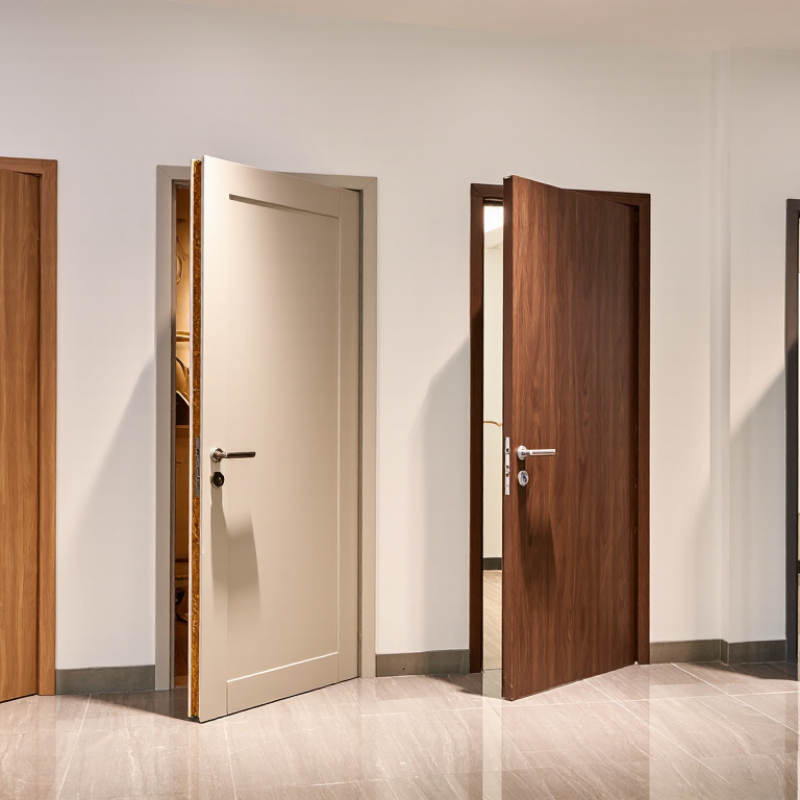
China commonly manufactures flush doors with MDF, HDF, plywood, or engineered timber cores. MDF doors provide a smooth surface for paint, laminate, or veneer. HDF versions usually offer better density and dent resistance. Plywood-core doors are often preferred where screw holding and dimensional stability matter. Solid timber flush doors feel more natural, but they can respond to humidity changes.
Common surface options include natural veneer, PVC film, melamine laminate, and painted finishes. Veneer gives each door visible grain variation. PVC film creates consistent color and easier cleaning. Melamine surfaces resist everyday scratches reasonably well. Painted doors can look refined, although poor edge preparation may reveal cracks later. Small details matter.
For bathrooms and humid rooms, moisture-resistant cores and sealed edges are essential. A decorative surface alone does not make a door waterproof. Check the core density, edge-banding method, hinge reinforcement, and hardware preparation before ordering. Samples should be tested for surface adhesion, warping, and color consistency. The door may look perfect in a showroom. It may behave differently after shipping and installation.
In practical sourcing, the best type depends on room use, climate, budget, and required finish. A heavy HDF door may suit a busy apartment corridor. A veneer plywood door may better fit a warm residential interior. One mistake is choosing by appearance alone. I would request technical drawings, tolerances, moisture data, and a complete sample before approving mass production.
Key Materials and Core Construction Options
When choosing a flush door from China, material and core construction deserve more attention than surface color. A smooth face can hide weak edges, moisture damage, or uneven bonding. Common skins include natural veneer, engineered veneer, PVC film, and painted fiberboard.
Natural veneer offers warm grain, but it needs stable humidity and careful sealing. Engineered veneer gives more consistent patterns and reduces variation between doors.
PVC film resists everyday stains, although peeling may occur when edge treatment is poor. Painted fiberboard looks clean, yet exposed corners can chip under repeated impact.
The core controls weight, stiffness, sound performance, and fire behavior.
Honeycomb paper cores are lightweight and economical for bedrooms or low-impact interiors. Hollow particleboard cores feel firmer and provide better screw holding. Solid wood or full particleboard cores improve durability, but they increase weight and may stress hinges.
Mineral or fire-rated cores require verified test documents for the target project. Do not accept a label alone. Check density, thickness, moisture resistance, edge sealing, and hardware reinforcement. A door can feel solid in a showroom and still warp after installation. That problem is easy to miss during a brief inspection.
Tips:
Request a cut-section photo or sample before ordering. Compare face thickness, core gaps, and stile construction. Ask how long the door was conditioned before packing. Confirm tolerances in writing. Inspect several units, not only one. Small differences matter. For humid rooms, specify sealed edges and moisture-resistant construction. Also consider local repair skills. An advanced core may be difficult to fix later. The cheapest specification is not always the most reliable one.
How to Compare Durability, Design, and Performance
What Is the Best Flush Door Type from China?
How to Compare Durability, Design, and Performance
A reliable flush door starts with its core, not its surface color. Honeycomb cores are light and economical, but solid or engineered cores usually resist impact better. For busy homes, hotels, and offices, check the door’s density, edge sealing, and moisture resistance. A dense door should close without excessive movement or hollow vibration.
Durability also depends on construction details. Inspect the frame joint, hinge reinforcement, and laminate adhesion. Ask for test reports covering bending, surface wear, sound reduction, and humidity exposure. Specifications can look impressive. Real samples reveal more. In my experience, a poorly sealed lower edge may swell after repeated cleaning, even when the face remains attractive. I once focused too much on the finish and overlooked hinge support. That was a useful mistake.
Tips: Compare complete door sets, not panels alone. Request a cutaway sample when possible. Check whether the stated dimensions match production samples. For design, review grain direction, edge lines, and color consistency under natural light. For performance, measure closing force, clearance, and noise during daily use. A clean, simple finish often hides fewer defects. Still, appearance is not everything. A beautiful door with weak hardware becomes frustrating quickly. Suppliers should explain material tolerances, inspection steps, packaging, and replacement procedures clearly. Be cautious when answers remain vague.
Manufacturing Standards, Quality Checks, and Certifications
What Is the Best Flush Door Type from China?
A reliable flush door starts with documented manufacturing standards, not attractive catalog photos. ISO 9001 quality systems matter because the ISO Survey 2022 recorded more than 1.26 million certified sites worldwide. Certification alone proves little, however. Buyers should request batch records, calibrated inspection tools, and corrective-action reports.
Check the core, surface, moisture, and dimensions. A 3-millimeter edge deviation can become visible after installation. Inspectors should measure door thickness, squareness, flatness, veneer bonding, and hinge reinforcement. For wood-based panels, EN 717-1 commonly uses the E1 formaldehyde limit of 0.124 mg/m³ in chamber testing. Ask for an accredited laboratory report, not a supplier’s internal spreadsheet.
Safety needs evidence.
For interior doors, relevant documentation may include fire-resistance test reports, acoustic test results, FSC chain-of-custody certification, and compliance with the destination market’s standards. EN 13501-2 classifies fire performance, while ISO 10140 evaluates laboratory sound insulation. Sampling should cover different production dates, not one perfect unit. In practice, humidity changes, imperfect packing, and rushed finishing still cause failures. A pre-shipment inspection, photographic records, and random destructive checks can reveal problems before containers leave China.
Choosing the Best Chinese Flush Door for Your Project
Choosing the best Chinese flush door starts with the project’s actual conditions. There is no universal best type. For bedrooms, hotels, and offices, a solid-core engineered flush door is often practical. It provides better sound control, stable dimensions, and a smooth surface for paint or laminate. For humid rooms, moisture-resistant materials and sealed edges deserve extra attention. Keep it simple.
Request a complete construction sheet from the Chinese supplier. Check the core density, face material, edge banding, adhesive, and moisture content. A reliable supplier should provide clear specifications and relevant test documents. Order a sample before approving mass production. Inspect its corners, surface flatness, hinge preparation, and closing action. Small defects become expensive when hundreds of doors arrive. I once underestimated packaging quality, and several edges were damaged during transport. That mistake still influences my inspection checklist.
Communication can determine the final result. Send drawings with exact sizes, wall thicknesses, hardware positions, and opening directions. Confirm tolerances in writing. For high-traffic areas, consider reinforced cores and stronger hinge fixing. For private rooms, a lighter construction may control costs. Do not choose only by price. A lower quote can hide thinner faces, weak edges, or unsuitable cores. Review carton protection, pallet loading, and delivery terms before production begins. Photograph the approved sample, because memory is not a specification.
What Is the Best Flush Door Type from China? - Choosing the Best Chinese Flush Door for Your Project
| Flush Door Type |
Typical Core and Surface |
Common Thickness |
Approx. Weight
900 × 2100 mm Leaf |
Typical Acoustic
Performance |
Moisture Resistance |
Relative Cost |
Best Application |
Overall Project Suitability |
| Hollow-Core Flush Door |
Honeycomb paper or lightweight grid core with a plywood, MDF, or laminate face. |
30–40 mm |
20–30 kg |
Approx. 20–25 dB |
Low to moderate |
Low |
Budget residential interiors, wardrobes, offices, and low-traffic rooms. |
★★★★☆ |
| Solid-Core Flush Door |
Particleboard, composite timber, or engineered wood core with a wood veneer, MDF, or laminate face. |
35–45 mm |
35–50 kg |
Approx. 28–32 dB |
Moderate to good |
Medium |
Bedrooms, hotel rooms, apartments, meeting rooms, and general commercial projects. |
★★★★★ |
| HPL-Faced Flush Door |
Solid or semi-solid engineered wood core with high-pressure laminate on both faces and matching edge treatment. |
35–45 mm |
35–50 kg |
Approx. 30–35 dB |
Good |
Medium to high |
Hospitals, schools, hotels, offices, corridors, and high-use interior areas. |
★★★★★ |
| Melamine-Laminated Flush Door |
Engineered wood or particleboard core with factory-applied melamine decorative paper on MDF or particleboard faces. |
32–40 mm |
30–45 kg |
Approx. 27–32 dB |
Moderate |
Low to medium |
Modern residential developments, offices, rental properties, and standardized projects. |
★★★★☆ |
| PVC-Membrane Flush Door |
MDF or engineered wood core covered with a vacuum-formed PVC film, including wrapped edges. |
32–40 mm |
28–42 kg |
Approx. 25–30 dB |
Good when edges are sealed |
Low to medium |
Kitchens, utility rooms, apartments, and interiors requiring easy cleaning and coordinated designs. |
★★★★☆ |
| Natural Veneer Flush Door |
Solid or engineered wood core with a thin natural wood veneer, usually protected by clear lacquer or other coating. |
35–45 mm |
35–50 kg |
Approx. 28–32 dB |
Moderate |
Medium to high |
Premium residences, executive offices, hotels, and projects emphasizing natural wood appearance. |
★★★★☆ |
| Certified Fire-Rated Flush Door |
Specially engineered mineral or composite core with tested facings, fire seals, compatible frame, and certified hardware. |
40–55 mm |
45–70 kg |
Approx. 30–38 dB |
Depends on finish |
Highest |
Exit routes, stairwells, plant rooms, public buildings, hotels, and code-regulated projects. |
★★★★★ |
Selection guide: For most general building projects, a solid-core HPL-faced flush door offers the best balance of durability, cleaning convenience, acoustic performance, and lifecycle value. For low-cost interior applications, choose a hollow-core door. For wet or frequently cleaned areas, specify sealed edges and moisture-resistant construction. For fire-protection applications, require a complete tested door-set certificate rather than relying only on the door leaf.
Note: The dimensions, weights, acoustic values, and performance ranges are typical estimates for comparison. Actual results depend on door size, core density, face material, edge sealing, frame design, hardware, installation quality, and the applicable testing standard.