Why Access Panels Are Essential for Effective Market Research Strategy
In the rapidly evolving landscape of market research, the importance of Access Panels cannot be overstated. As industry experts emphasize, these curated groups of respondents provide valuable insights that can shape effective strategies for brands across various sectors. Dr. Sarah Thompson, a renowned market research consultant, states, "Access Panels are the backbone of insightful consumer research, enabling companies to tap into genuine sentiments and behaviors." This underscores the pivotal role of Access Panels in deriving meaningful data that goes beyond surface-level insights.
Access Panels offer a diverse pool of participants, allowing researchers to gather nuanced information reflective of different demographics and preferences. By leveraging these panels, organizations can conduct studies that are not only cost-effective but also time-efficient. Furthermore, the ability to engage with targeted audiences ensures that researchers can address specific inquiries with greater accuracy and relevance. In doing so, Access Panels become an instrumental tool in enhancing market research efficacy, ultimately leading to more informed business decisions.

The Role of Access Panels in Streamlining Market Research Processes
Access panels play a pivotal role in streamlining market research processes by providing researchers with ready access to a diverse pool of participants. These panels are composed of individuals who have voluntarily agreed to take part in studies, ensuring that researchers can quickly find respondents that fit specific demographic and psychographic profiles. This immediate access eliminates the lengthy recruitment phase often associated with traditional research methods, allowing for faster data collection and analysis.
Moreover, the use of access panels enhances the quality of insights gained from market research. By leveraging an established panel, researchers can engage with participants who are not only interested but also possess relevant experience or knowledge about the topics being studied. This leads to more meaningful feedback and richer data, which can lead to actionable results. Additionally, the ability to conduct longitudinal studies with the same group of respondents over time allows for better tracking of changes in attitudes and behaviors, providing deeper insights into market trends. Overall, access panels significantly reduce time and costs while elevating the effectiveness of market research strategies.
Why Access Panels Are Essential for Effective Market Research Strategy - The Role of Access Panels in Streamlining Market Research Processes
| Dimension |
Description |
Importance |
Impact on Market Research |
| Speed |
Access panels facilitate quicker data collection from pre-recruited respondents. |
High |
Accelerates the overall research timeline, allowing for timely insights. |
| Cost-Effectiveness |
Utilizing access panels often reduces expenses compared to traditional sampling methods. |
Medium |
Enhances budget management and allows for more studies within the same budget. |
| Diversity |
Access panels can offer diverse respondent bases, representing various demographics. |
High |
Provides richer data and insights that are more generalizable to the target market. |
| Quality of Data |
Access panels often maintain quality through screening processes and regular engagement. |
High |
Improves the reliability of insights drawn from the research. |
| Flexibility |
Access panels allow researchers to adapt surveys based on emerging trends quickly. |
Medium |
Helps in capturing timely insights that are relevant to current market conditions. |
Benefits of Access Panels: Enhancing Data Quality and Response Rates
Access panels have become a cornerstone of effective market research strategies, primarily due to their ability to significantly enhance data quality and improve response rates. According to a report by Research Now SSI, using access panels can increase survey participation rates by up to 30%, allowing researchers to gather a more substantial and representative dataset. This enhanced response rate is crucial in overcoming the common challenges of participant fatigue and disengagement, leading to insights that are not only more reliable but also actionable.
One of the critical benefits of access panels lies in their ability to provide a diverse audience pool. This diversity enables researchers to segment data effectively, resulting in more tailored findings. Data from the Insights Association highlights that studies leveraging access panels show a 20% improvement in data validity compared to traditional sampling methods. By decreasing the biases often present in conventional research, access panels help ensure that the insights derived reflect the true preferences and behaviors of the target market.
Tips for maximizing the effectiveness of access panels include maintaining clear and concise survey designs, which can lead to higher completion rates. Additionally, incentivizing panel members appropriately can foster long-term engagement, ensuring they remain active participants in future studies. Finally, regularly refreshing the panel to include new members can keep the data fresh and relevant, further enhancing the overall quality of research outcomes.
Impact of Access Panels on Market Research Outcomes
Comparative Analysis: Access Panels vs. Traditional Research Methods
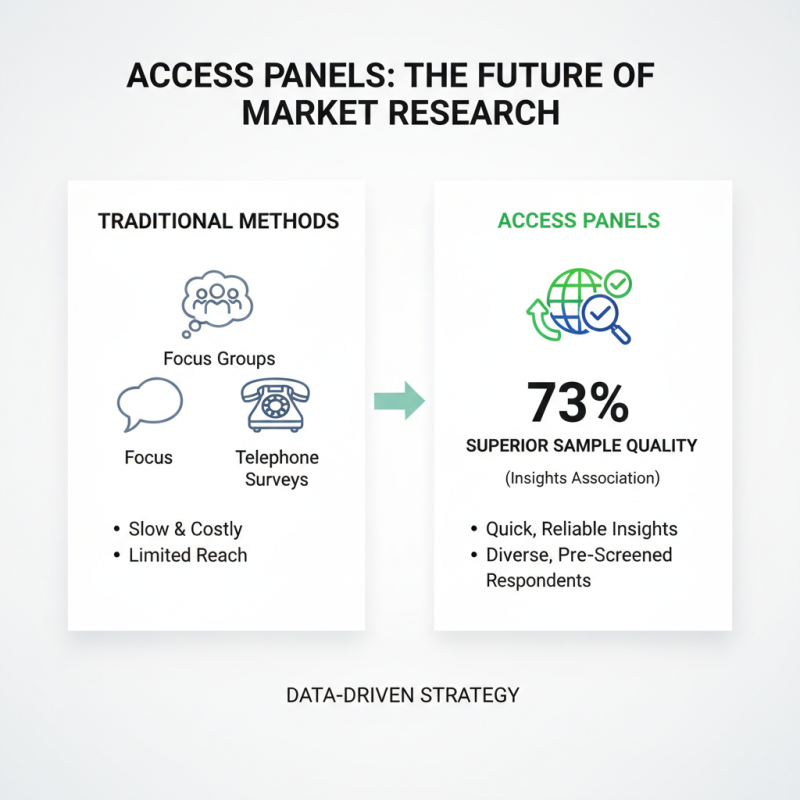
Access panels have emerged as a crucial component of modern market research strategies, offering distinct advantages over traditional research methods such as focus groups or telephone surveys. One of the primary benefits of access panels is the ability to gather quick and reliable insights from a diverse pool of respondents. According to a recent report by the Insights Association, 73% of researchers believe that access panels provide superior sample quality compared to traditional sampling methods. This is due in part to the ability of access panels to pre-screen participants, ensuring that they meet specific demographic criteria and are engaged in the research process.
In contrast, traditional methods often struggle with longer timelines and potential sampling biases, limiting their effectiveness in fast-paced market environments. A study by Market Research Future indicates that online access panels can reduce research timelines by up to 50%, enabling companies to respond to market trends and consumer insights rapidly. Moreover, access panels facilitate ongoing engagement with respondents, allowing businesses to track changes in consumer behavior over time, a capability that traditional methods typically lack. This dynamic nature of access panels not only enhances data accuracy but also provides a more comprehensive understanding of customer needs and preferences.
The flexibility and efficiency of access panels make them indispensable in today’s data-driven environment. As highlighted by the Data and Marketing Association, companies utilizing access panels report improved decision-making processes and increased ROI on marketing campaigns, demonstrating the profound impact of using modern research techniques over traditional approaches.
Industry Statistics: The Impact of Access Panels on Research Timeliness
Access panels have become a pivotal asset in market research, particularly when it comes to enhancing the timeliness of research findings. According to recent industry statistics, organizations utilizing access panels can significantly reduce the time it takes to gather valuable consumer insights. By providing pre-recruited participants who are ready and willing to share their opinions, access panels eliminate the lengthy processes associated with traditional survey methods, which often involve recruiting from scratch. This agility not only accelerates research cycles but also allows companies to respond promptly to market changes and consumer needs.
Moreover, the effectiveness of access panels is underscored by their ability to deliver diverse demographic insights rapidly. Research shows that access panels often contribute to achieving higher response rates, resulting in a more robust data set for analysis. The speed at which data can be collected and analyzed means that organizations can maintain a competitive edge, adjusting their strategies in real-time based on consumer feedback. Overall, the integration of access panels within market research strategies is not just advantageous; it is essential for maintaining relevance in today's fast-paced market environment.
Case Studies: Successful Market Strategies Leveraging Access Panels
Access panels have emerged as a pivotal element in market research strategies, enabling companies to gather valuable insights quickly and efficiently. A recent report by ESOMAR highlighted that over 70% of market researchers utilize access panels to enhance their data collection processes. One notable case study involved a consumer goods company that leveraged access panels to conduct a rapid product testing phase. By connecting with a diverse panel of over 1,000 participants, they were able to gather quantitative feedback in less than a week, leading to adjustments that increased product market fit and boosted sales by 25% within the first quarter of launch.
Another example illustrates the effectiveness of access panels in the tech industry, where a software firm utilized a specialized panel to gauge user experience and satisfaction. By segmenting their panel based on user demographics and behavior, they gathered detailed qualitative insights that informed their product development roadmap. The outcome was a notable decrease in churn rates by 15%, showcasing how strategically leveraging access panels can drive customer retention and loyalty.
Tips for maximizing the benefits of access panels include ensuring diversity within your panel to avoid bias, and regularly updating panelist profiles to maintain relevance. Additionally, fostering engagement with panelists can enhance response rates and the quality of insights gathered. By employing these strategies, organizations can transform the use of access panels into a robust component of their market research efforts.